
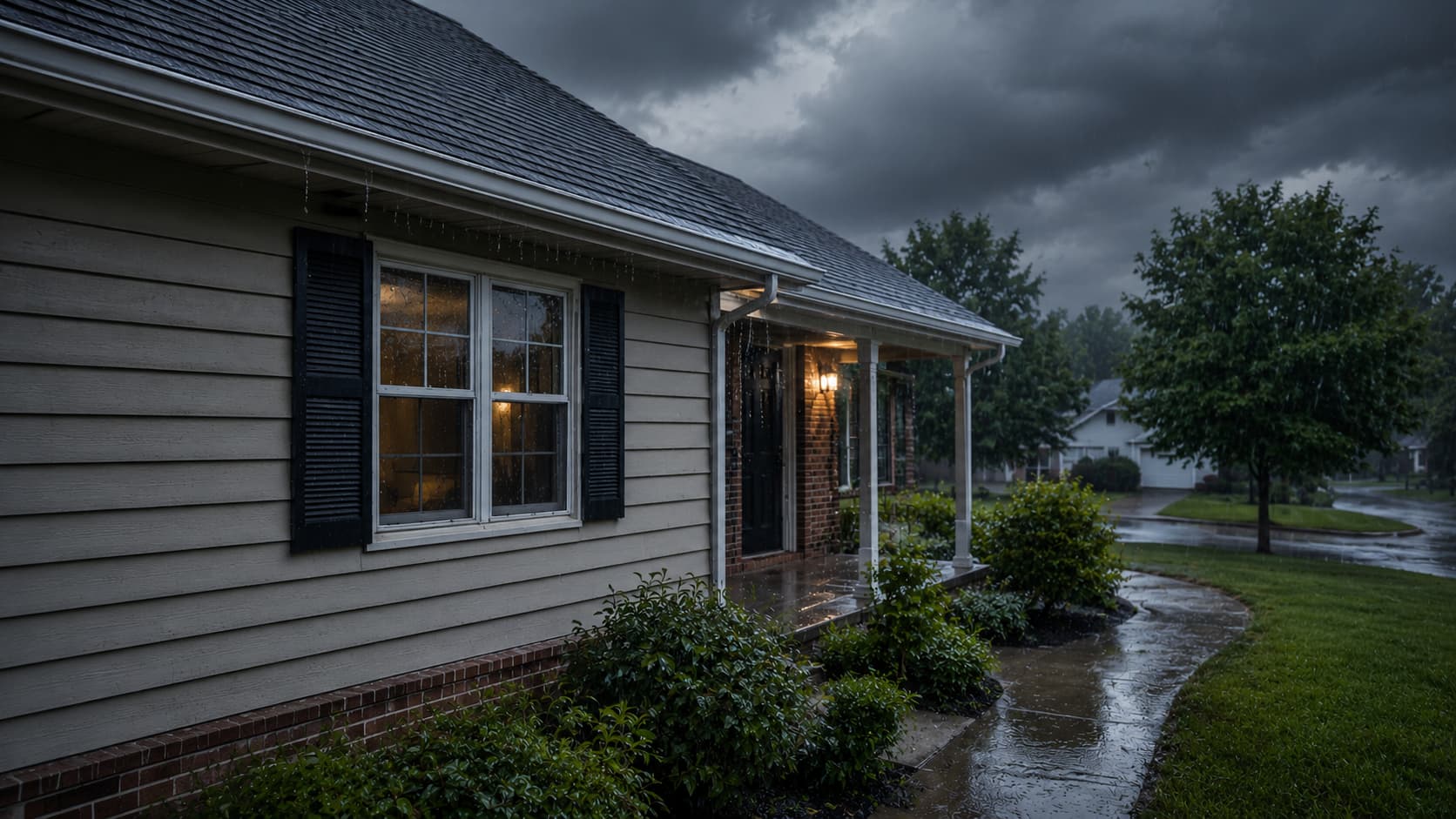
Summer thunderstorms in Chester County and Bucks County don't ease in — they arrive fast, hit hard, and drop more water than most homeowners expect. In some cases, a single storm event can drop over an inch of rain in less than 45 minutes. That's a lot of water moving through your gutters in a very short window, and if your system isn't ready, the consequences can show up quickly.
Understanding what actually happens to your gutters during a heavy storm is the first step toward protecting your home from water damage that's both preventable and expensive.
The Volume Problem
Your gutters are sized to handle a normal rain rate — typically around 1 inch of rainfall per hour. When a thunderstorm exceeds that rate, even a clean and fully functional gutter system can be temporarily overwhelmed. Water cascades over the front edge rather than flowing to the downspout, and it lands in places you don't want it: next to your foundation, against your siding, and into mulched planting beds.
Now imagine that same storm hitting gutters that are 30 or 40 percent full of debris. The effective capacity drops dramatically. What would have been manageable overflow becomes a full blowout — water pouring over the sides, backing up under the drip edge, and sitting against your fascia boards.
Where the Damage Actually Happens
During and after a storm event, the most common areas of gutter overflow rain damage in residential homes include:
- Foundation perimeter — water concentrating near the base of the home from overflowing front gutters
- Basement and crawlspace — hydrostatic pressure builds when water can't drain away from the foundation
- Fascia and soffit — sustained moisture exposure rots the wood behind and beneath the gutter channel
- Siding and exterior paint — streaking, bubbling, and mold growth from repeated overflow contact
- Landscaping — soil erosion and plant loss directly below high-overflow points
What Clogged Downspouts Do in a Storm
Downspouts are the exit point for everything your gutters collect. During a heavy summer storm, a partially clogged downspout backs up quickly. That backup creates hydrostatic pressure inside the gutter channel itself — causing water to find the path of least resistance, which is often a loose end cap, a seam, or directly over the front lip.
Many homeowners don't realize their downspouts are clogged until they watch water spill from the middle of a gutter run rather than the corner. By that point, the storm is already doing damage.
The Compounding Effect After the Storm
One storm event with clogged gutters doesn't always cause visible damage immediately. But repeated overflow through the summer season compounds the effect. Fascia boards absorb moisture across multiple storms. Soil near the foundation stays saturated between events. Mold begins forming in the organic debris sitting in the gutter channel itself.
What starts as a minor inconvenience in June can become a structural repair conversation by September.
The Simple Fix: Clean Gutters Before Storm Season
The most effective way to limit gutter overflow rain damage during summer storms is also the most straightforward: start the season with clean, clear gutters and clear downspouts. A professional cleaning in late spring removes the debris load that reduces capacity, and a flow check confirms your downspouts are draining freely.
ClearFlow Gutter Cleaning serves homeowners across Chester County, Bucks County, and surrounding communities. We're veteran-owned and built on doing the job right the first time.
Call ClearFlow Gutter Cleaning at (215) 932-7968 or request a free estimate online: